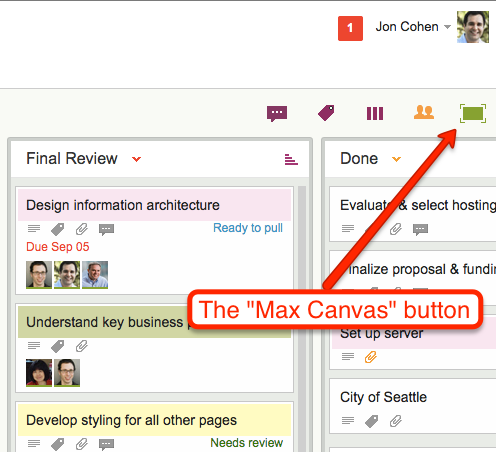
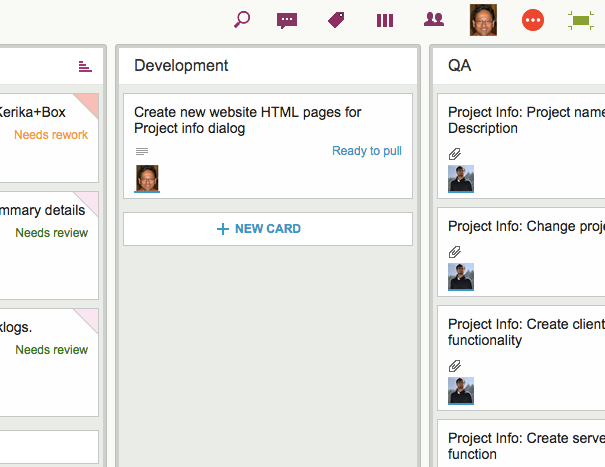
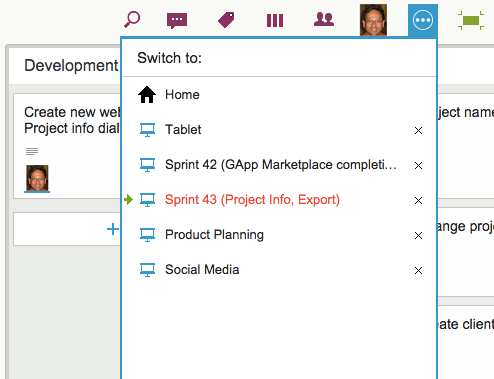
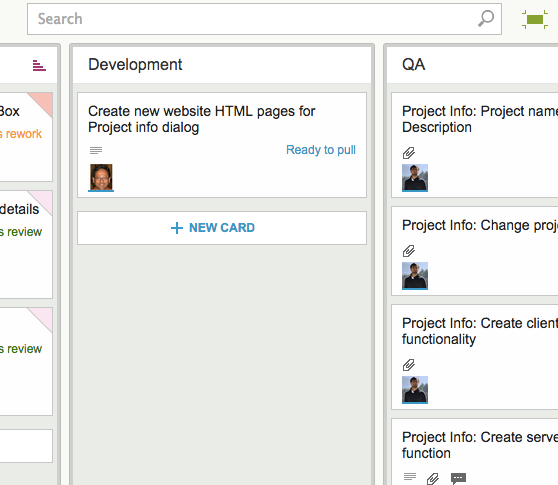
We have been putting in a ton of effort to improve the Kerika user experience on tablets: while Kerika runs OK in the Safari and Chrome browsers on iPads, the experience is somewhat uneven across other tablets, particularly Android and Windows tablets and “convertibles”.
It’s a little frustrating to find so many oddities about Internet Explorer 11 (the latest, greatest version from Microsoft) when it comes to Windows 8.1 tablets and convertibles.
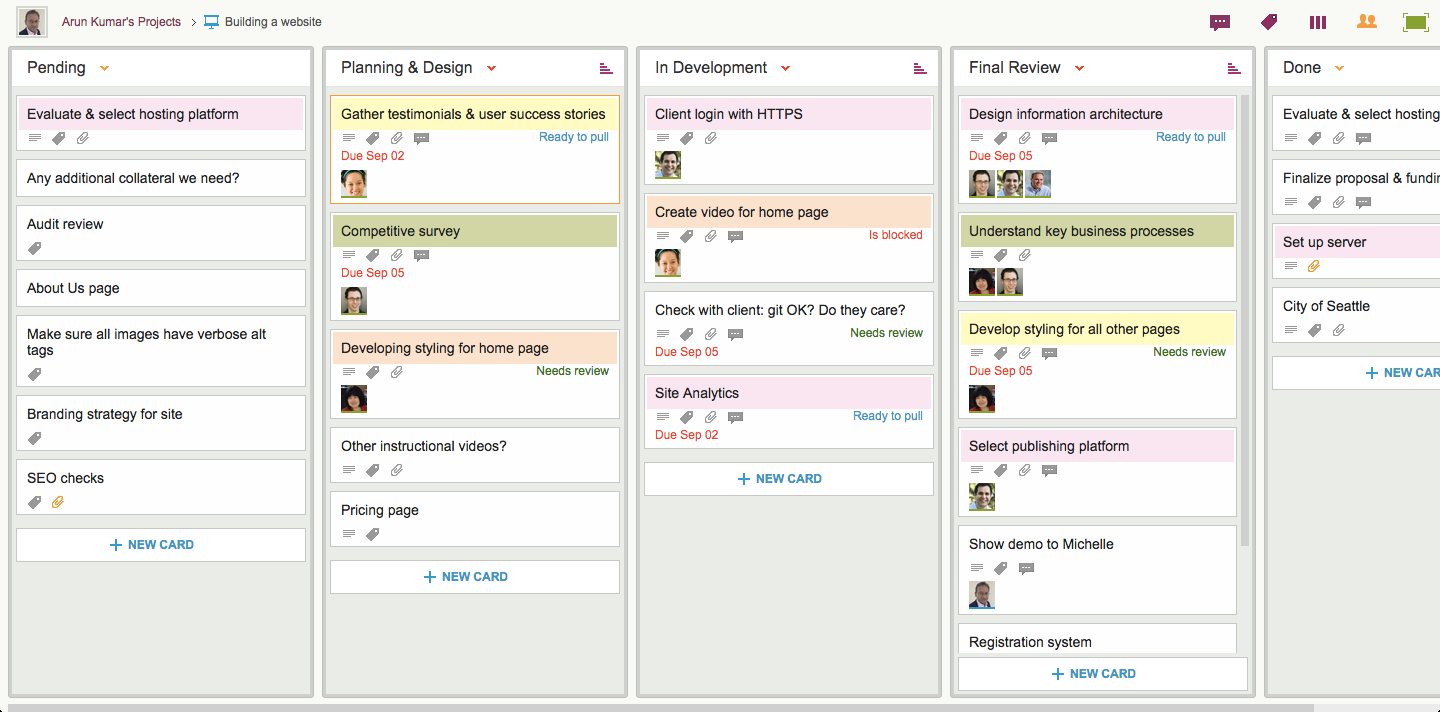
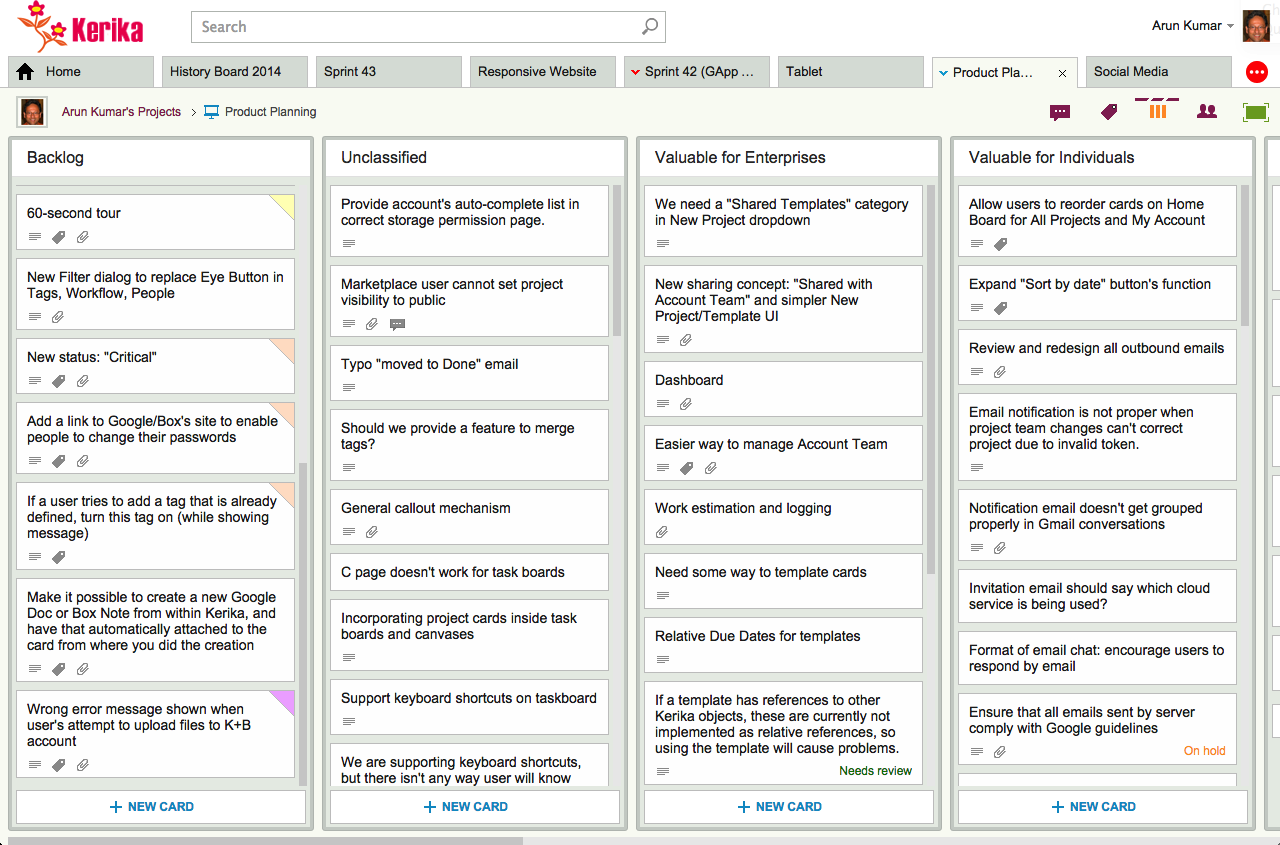
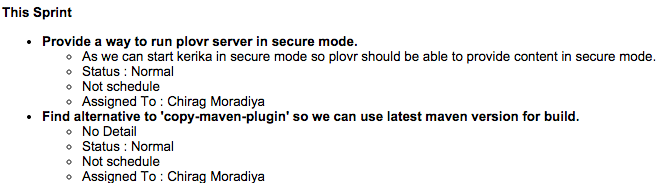
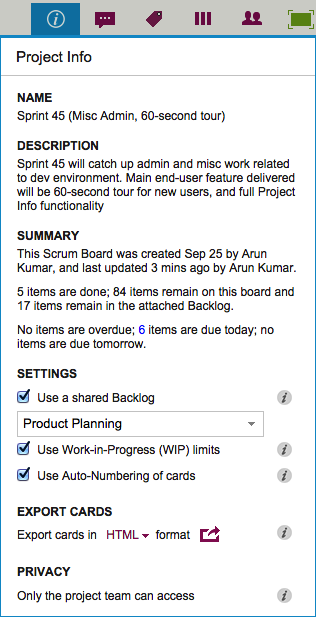
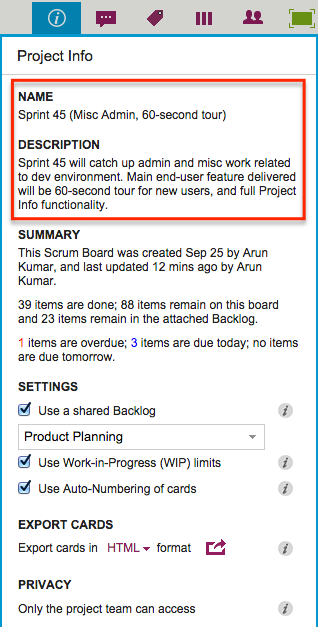
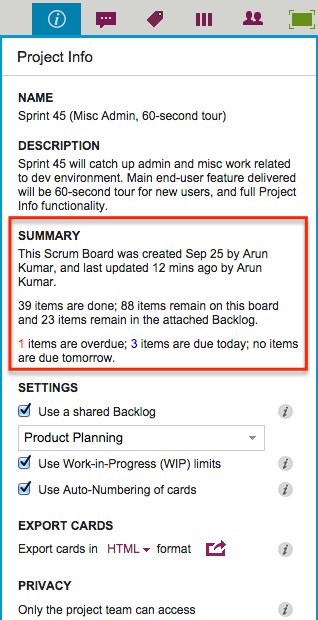
Looking at our internal Scrum Board for our tablet work, we are struck by the many ways in which the touch and swipe gestures in Internet Explorer are different from the Webkit-based browsers (Safari and Chrome):
I met my old lover
On the street last night
She seemed so glad to see me
I just smiled
And we talked about some old times
And we drank ourselves some beers
Still crazy after all these years
Oh, still crazy after all these years
We are now dealing with two different user communities!
People are signing up for our new Kerika+Box product, and we are continuing to grow our Kerika+Google user base.
Next up: we are upgrading our Google Apps Marketplace integration to also use OAuth 2.0, so that all logins to Kerika will be with OAuth 2.0, across all platforms.
The background to this work is slightly wonky, and reflects the way Google Apps Marketplace has evolved within the Google ecosystem.
If you sign up for Kerika+Google today, you actually go through a OAuth 2.0 authentication and authorization process with Google, which gives us your basic profile information (name, email, photo) that we use to set up your Kerika+Google account, as well as access to your Google Docs.
Google has deprecated OAuth 1.0, so we are updating our Google Apps Markeplace to also work with OAuth 2.0, just like a regular sign-up through Kerika.com.
This change will not affect any existing users: the most visible effect will be on our Sign Up page, which will start to show three options for new users:
Sign up for a Kerika+Box account: this will work as it does today – it will use OAuth 2.0 to set up a Kerika account using your Box credentials (name, email address, and access to your Box account to store your Kerika-related files).
Sign up for a Kerika+Google account: this will also work as it does today – it will use OAuth 2.0 to set up a Kerika account using your regular Google credentials (e.g. Gmail ID, YouTube ID) and store your Kerika-related files in your Google Drive.
On LinkedIn’s Scrum Alliance group someone recently posed this question:
Which is more effective agile software project management tool MS Project or a agile software project management tool for implementing scrum?
Here’s my response:
I started using MS Project around 1989 — must have been close to v1.0, I imagine — and even back then, when it was a relatively simple tool, it never delivered enough utility to warrant the immense hassle of trying to keep it updated so that it actually reflected the reality of a fast-moving project.
The phrase that came to mind often was “I have to feed the beast again“, i.e. I have to spend hours each day trying to map all the real-time changes that were happening in the real-world to the fake world modeled in MS Project.
The MS Project world wasn’t fake because I was incompetent: it was fake because it was always instantly out-of-date.
And as MS Project has gotten larded with more bells and whistles, it has never been able to address its fundamental shortcoming: it is a theoretical model of what you would like your project to be, rather than a practical/actual reflection of what your project is.
So, even back in the 1980s, before people were talking about Agile and Scrum, we were all actually living in an Agile/Scrum world; we just didn’t have that realization, and we didn’t have the appropriate tools to deal with a fast-changing project environment.
At Kerika, we live and breathe in a distributed Agile world: our team is spread out between Seattle and India, which means we never have any overlapping time, but by using Kerika scrum boards we are in perfect synch with each other.
We know exactly what everyone else is up to, and we are able to process, on average, 10-12 cards per week, per person, on a sustained basis.
Kerika also has a whiteboard capability so we are able to do brainstorming and design work.
Is MS Project useful for anything at all? Yes, if your project…
a) Is considered immutable from the very start.
An example would be a government contract which is negotiated up-front in painful detail, and your success is defined only in terms of whether you delivered exactly what was specified, not whether the final product was useful. (Business-as-usual for most Federal contracts.)
b) Every aspect of the technology has been prototyped, tested, and proven already, so uncertainties are minimized.
This is an interesting use-case of mixing Scrum and Waterfall that’s not explored very often, where you use Agile to do your R&D and figure out workable solutions to your biggest uncertainties, and then use Waterfall to build the final version.
At long last, and with considerable effort, we finished and released Kerika+Box: a seamless integration of Kerika with the Box cloud storage platform.
Kerika+Box works just like Kerika+Google, the old integration of Kerika with Google Drive: both offer a complete work management system that works seamlessly with your cloud storage platform of choice.
We are really excited about this new release; we have found that there are a ton of advantages to using Box as a cloud storage platform:
It’s free for personal use, which means it’s easy to get started.
You can sign up with an existing email address: you don’t need to get a new ID.
It’s got the best security and enterprise management features of any cloud storage platform out there.
The company is very accessible and offers great support.
We have also updated our website, to make it more responsive (i.e. display better on mobile devices), and we have included a number of customer profiles to give you an idea of the very broad range of people who are using Kerika.
We have a growing community of users in various agencies within Washington State government, and we are happy to provide the essential project management and team collaboration tool needed to achieve the Governor’s mandate for “Lean Government”.
Among other agencies, we are proud to serve people in:
To help folks within Washington State agencies understand how (and when and why…) they should Kerika, we have partnered with the state’s Office of the CIO to produce a quick guide to Using Kerika for State Government Work:
Eleven months ago, somewhat bemused by the surprising number and variety of LinkedIn endorsements I was getting, I wrote a blog post graphing the “long tail” of these endorsements:
LinkedIn endorsements (August 2013)
At that time, I was astonished to find that I had a total of 251 endorsements across 35 categories of skills!
I was fairly certain I had maxed out, and was sure that the entire practice of LinkedIn endorsements would die out altogether since I felt the currency had become already become devalued: LinkedIn was aggressively suggesting endorsements to all users, pretty much every time they logged into the site, and this was creating an inflationary bubble.
So, 11 months later, what does the picture look like?
LinkedIn endorsements (July 2014)
What had previously seemed an unrealistic set of numbers (251 endorsements across 35 categories), is now 411 endorsements across 50 categories.
The tail is even longer, as you can see: 10 categories where I have 1 endorsement only in each category, and 15 categories where I have just 2 endorsements each.
Last year, the top 5 categories represented 55% of all my endorsements; this year, the top 5 categories represent 50% of all my endorsements — more proof that the tail is flattening and lengthening.
And in my previous post, I had argued that LinkedIn was hair-splitting: too many categories sounded like they were the same.
This year, the effect seems even more pronounced; here are categories that I would recommend be collapsed together to provide a more coherent picture of a person’s skills:
Entrepreneurship, Board of Directors, Board of Directors Experience (really?), Startups together as “Entrepreneurship”, because all of that relates to the startup world.
Cloud Computing, Scalability, SaaS together as “Cloud” because all that relates to, well, cloud.
Online Marketing, Go-to-market Strategy, Competitive Analysis, SEO, Product Management: all this is part of “Marketing”.
Program Management, Project Management, Software Project Management, IT Management, PMO, SDLC together as “Program Management”.
Strategy, Strategic Planning, Management Consulting, Consulting together as Strategy.
Enterprise Software, Integration, Outsourcing together under something I would prefer to call “Big Company IT”.
Management, Executive Management, Team Leadership, Cross-functional Team Leadership, Leadership, Communication Skills all are part of “Leadership”.
Business Process, Process Improvement and Business Process Automation could be just “Business Processes”.
Analytics and Business Intelligence could be together.
Acquisitions and Mergers & Acquisitions should certainly be together!
If I normalized this data, it would look like this:
Normalized LinkedIn Endorsements
Now my top 5 categories account for 66% of all my endorsements, which would give you a much sense of my skills!
Maybe I should award myself an extra endorsement for “Analytics”?
Eleven months ago, somewhat bemused by the surprising number and variety of LinkedIn endorsements I was getting, I wrote a blog post graphing the “long tail” of these endorsements:
LinkedIn endorsements (August 2013)
At that time, I was astonished to find that I had a total of 251 endorsements across 35 categories of skills!
I was fairly certain I had maxed out, and was sure that the entire practice of LinkedIn endorsements would die out altogether since I felt the currency had become already become devalued: LinkedIn was aggressively suggesting endorsements to all users, pretty much every time they logged into the site, and this was creating an inflationary bubble.
So, 11 months later, what does the picture look like?
LinkedIn endorsements (July 2014)
What had previously seemed an unrealistic set of numbers (251 endorsements across 35 categories), is now 411 endorsements across 50 categories.
The tail is even longer, as you can see: 10 categories where I have 1 endorsement only in each category, and 15 categories where I have just 2 endorsements each.
Last year, the top 5 categories represented 55% of all my endorsements; this year, the top 5 categories represent 50% of all my endorsements — more proof that the tail is flattening and lengthening.
And in my previous post, I had argued that LinkedIn was hair-splitting: too many categories sounded like they were the same.
This year, the effect seems even more pronounced; here are categories that I would recommend be collapsed together to provide a more coherent picture of a person’s skills:
Entrepreneurship, Board of Directors, Board of Directors Experience (really?), Startups together as “Entrepreneurship”, because all of that relates to the startup world.
Cloud Computing, Scalability, SaaS together as “Cloud” because all that relates to, well, cloud.
Online Marketing, Go-to-market Strategy, Competitive Analysis, SEO, Product Management: all this is part of “Marketing”.
Program Management, Project Management, Software Project Management, IT Management, PMO, SDLC together as “Program Management”.
Strategy, Strategic Planning, Management Consulting, Consulting together as Strategy.
Enterprise Software, Integration, Outsourcing together under something I would prefer to call “Big Company IT”.
Management, Executive Management, Team Leadership, Cross-functional Team Leadership, Leadership, Communication Skills all are part of “Leadership”.
Business Process, Process Improvement and Business Process Automation could be just “Business Processes”.
Analytics and Business Intelligence could be together.
Acquisitions and Mergers & Acquisitions should certainly be together!
If I normalized this data, it would look like this:
Normalized LinkedIn Endorsements
Now my top 5 categories account for 66% of all my endorsements, which would give you a much sense of my skills!
Maybe I should award myself an extra endorsement for “Analytics”?
(The ninth in a series of blog posts on why we are adding integration with Box, as an alternative to our old integration with Google Drive.)
We have been doing internal testing (“eating our own dogfood”) of Kerika+Box for the past three weeks, and the results have been much better than we expected!
We have found very few bugs so far, which is great — it’s feels like a huge vindication of our decision to invest several Sprints in improving our internal QA processes, clearing the backlog of old bugs, and generally improving our software development processes with code reviews across the board, for even the smallest changes.
In other words, we didn’t move fast and break things: we moved slowly and broke nothing. Which makes sense when you have paying customers who rely upon your product to run their businesses…
Since Kerika makes it really easy to have multiple backlogs in a single account, we put all the OAuth and infrastructure work in a separate backlog, allowing a part of the team to concentrate on that work somewhat independently of other, more routine work like bug fixes and minor usability updates.
And, as before, put every feature in a separate git branch, making it easy to merge code as individual features get done.
Here’s what our Box QA board looks like, right now:
Box QA board
The user interface for Kerika+Box is essentially the same as for Kerika+Google, with a few quirks:
Box requires more frequent logins: Google provided us with relatively long-lived refresh tokens, so a user could close a Kerika browser tab and reopen it a day later and log right back in.
With Box, you are going to see a login screen much more often, along with a screen asking you to re-authorize Kerika as a third-party app that can access your Box account.
This is kind of irritating, but apparently unavoidable: from what we have found on Stack Overflow, Bug views this as a feature rather than a bug.
The other, really big difference is that files are edited offline rather than in the browser itself: when you click on the Edit button, you will end up downloading a local copy of the file, using Microsoft Office for example, and then when you do a Save of that file, your latest changes are uploaded automatically to the cloud.
Here’s what you see when you open a file attached to a card on a Kerika board, when you use Kerika+Box:
Example of opening a file within Box
This works great most of the time, except when two people are making changes simultaneously: in that situation, Google’s in-browser editing seems a lot more convenient.
On the other hand, downloading local copies of files means that you get the full power of Microsoft Office, and we know that’s very important for some of our users, e.g. consultants dealing with complicated RFPs or government users dealing with official documents.
Performance also seems a little less than Google Drive, although we would stress that this is highly variable: while Google Drive files generally open within 1-3 seconds in a new browser tab, they can take much longer if Google’s servers are slow.
Overall, we are very pleased with Kerika+Box: we are planning to do all of our new development with this new platform, to continue eating our delicious dogfood ;-)
Dan Genz from the Washington State Auditor’s Office gave a presentation at the 2014 IPMA Forum describing how the state agency is adopting Lean principles, while serving hundreds of state, county and local municipalities with a distributed team of auditors and analysts spread out across the state:
Will Treinen, founder and CEO of Treinen Associates gave a presentation at the 2014 IPMA Forum describing his experiences in building an “Agile PMO” to handle the extraordinary growth of his consulting business (600% in the past year!).
Will relied upon Kerika to create the perfect collaboration environment for his distributed teams of project managers, business analysts and business development staff: